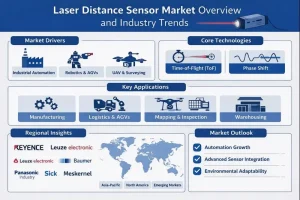

As demand grows for compact, embedded distance measurement in robotics, automation, and unmanned systems, laser rangefinder OEM modules are becoming a critical component in many new product designs. Unlike finished laser sensors, OEM modules are designed for direct system integration, offering greater flexibility in form factor, firmware control, and long-term cost optimization.
For system integrators and equipment manufacturers, selecting the right laser rangefinder OEM module can significantly influence performance, integration timelines, and product scalability. This article outlines the technical considerations, integration challenges, and supplier landscape shaping the OEM laser rangefinder market.
Growing Demand for OEM Laser Rangefinder Modules
Laser rangefinder OEM modules are increasingly used in applications where standard, enclosed sensors cannot meet system-level requirements. These include mobile robotics, industrial automation, UAVs, smart infrastructure, and embedded measurement equipment.
The shift toward OEM modules reflects broader industry trends: tighter mechanical integration, customized firmware behavior, and the need to optimize bill-of-materials costs for mass production. As a result, system integrators are placing greater emphasis on component-level flexibility rather than ready-made sensing products.
What Defines a Laser Rangefinder OEM Module?
A laser rangefinder OEM module is a compact distance-measuring unit intended to be embedded into a larger device or system. In contrast to finished laser distance sensors, OEM modules typically:
- Are supplied without protective housings or user interfaces
- Output raw distance data via digital communication interfaces
- Require mechanical and electrical integration by the system designer
- Support varying degrees of firmware configuration or customization
These characteristics make OEM modules particularly suitable for ODM and custom hardware projects.
Key Technical Factors System Integrators Evaluate
When assessing laser rangefinder OEM modules, integrators typically look beyond headline specifications and focus on integration-related criteria.
Measurement Performance
Key metrics include operating range, accuracy, repeatability, and reliability under varying ambient light conditions. Outdoor and high-glare environments remain a major consideration in many industrial and robotic deployments.
Electrical Interfaces and Power Requirements
Common interfaces include UART, I²C, SPI, and CAN. Voltage compatibility, power consumption, and protocol documentation are often decisive factors during early design stages.
Mechanical Integration Constraints
Module dimensions, mounting methods, optical alignment, and thermal characteristics can directly affect enclosure design and system stability.
Firmware Flexibility
OEM projects frequently require control over output frequency, filtering algorithms, or data formats. Modules that allow firmware configuration or customization are often preferred in long-term production programs.
Integration Challenges Driving OEM Adoption
System integrators cite several recurring challenges when embedding laser distance measurement into new products:
- Measurement instability in strong ambient light
- Limited access to communication protocols
- Mechanical redesign caused by fixed sensor housings
- Supply risks associated with short product lifecycles
OEM laser rangefinder modules are often selected to mitigate these risks by offering earlier design flexibility and closer collaboration with manufacturers.
OEM Modules vs. Finished Laser Sensors
While finished laser sensors remain suitable for many use cases, OEM modules offer distinct advantages in embedded systems:
| Finished Laser Sensors | OEM Laser Rangefinder Modules |
|---|---|
| Predefined housing | Custom enclosure integration |
| Fixed firmware behavior | Configurable or customizable firmware |
| Limited interface options | Multiple or tailored interfaces |
| Higher unit cost | Optimized cost for scale |
For products moving toward mass production or differentiation, OEM modules are increasingly favored.
Application Areas Driving Market Growth
Laser rangefinder OEM modules are widely deployed across industries, including:
- Autonomous mobile robots and navigation systems
- UAV altitude sensing and obstacle avoidance
- Industrial positioning and distance control
- Smart infrastructure and parking systems
- Surveying and precision measurement equipment
In each case, the ability to adapt the module to specific system requirements is a primary driver of adoption.

Selecting an OEM Supplier: Common Evaluation Criteria
Before finalizing an OEM laser rangefinder supplier, system integrators typically assess:
- Availability of samples and low-volume prototyping
- Customization capabilities and associated lead times
- Long-term supply stability and lifecycle management
- Technical support during integration and deployment
These considerations often outweigh brand recognition alone in OEM decision-making.
Industry Landscape: Laser Rangefinder OEM Module Suppliers
The laser rangefinder OEM module market includes a mix of specialized manufacturers and established sensing technology providers. The following companies are representative industry participants. This overview is provided for reference only and does not constitute a ranking or endorsement.
Asia
Meskernel
A manufacturer focused on laser distance measurement technologies, offering OEM and ODM laser rangefinder modules for industrial, robotics, and embedded applications, with an emphasis on customization and integration support.
Benewake
Known for compact laser distance modules used in UAVs, robotics, and obstacle avoidance systems.
RoboSense
Primarily recognized for LiDAR solutions, with laser sensing technologies applied in autonomous and robotic platforms.
Europe
Jenoptik
Supplies laser-based measurement solutions for industrial and automation-related applications.
LMI Technologies
Develops industrial sensing and measurement technologies, including laser-based distance and profiling systems.
North America
Laser Technology Inc.
Provides laser measurement technologies used in surveying and industrial environments.
Garmin (Industrial and OEM Sensing)
Offers optical and laser sensing technologies applied in navigation and measurement systems.
Frequently Asked Questions About Laser Rangefinder OEM Modules
-
What is a laser rangefinder OEM module?
A laser rangefinder OEM module is an embedded distance-measuring component designed for integration into custom hardware systems. Unlike finished laser sensors, OEM modules typically lack a housing or display and provide raw distance data through digital interfaces, allowing system integrators to build customized products around them.
-
How is an OEM laser rangefinder module different from a standard laser distance sensor?
The main difference lies in integration flexibility. Standard laser distance sensors are ready-to-use products with fixed enclosures and firmware, while OEM laser rangefinder modules are intended for internal integration, offering more control over mechanical design, interfaces, firmware behavior, and overall system cost.
-
Can laser rangefinder OEM modules be customized?
Yes. Many manufacturers offer customization options for laser rangefinder OEM modules, including firmware adjustments, communication protocols, output formats, measurement frequency, and sometimes mechanical form factor. The level of customization varies by supplier and project volume.
-
What interfaces do laser rangefinder OEM modules usually support?
Common interfaces include UART, I²C, SPI, and CAN. Some OEM modules also support customized communication protocols depending on application requirements. System integrators should confirm interface compatibility early in the design phase.
-
Are laser rangefinder OEM modules suitable for outdoor use?
Certain laser rangefinder OEM modules are designed for outdoor applications and can operate under strong ambient light. Performance depends on factors such as laser wavelength, optical filtering, signal processing, and firmware algorithms. Outdoor use cases should always be validated through real-world testing.
-
What industries typically use laser rangefinder OEM modules?
Laser rangefinder OEM modules are widely used in robotics, industrial automation, UAVs, smart infrastructure, surveying equipment, and embedded sensing systems where space constraints, customization, and scalability are critical.
-
What should buyers consider when selecting a laser rangefinder OEM module supplier?
Key considerations include measurement performance, interface compatibility, customization capability, long-term supply stability, technical support, and the ability to support both prototyping and mass production. Choosing the right OEM partner can significantly reduce integration risks.
-
Is there a minimum order quantity (MOQ) for OEM laser rangefinder modules?
MOQ requirements vary by manufacturer. Some suppliers support low-volume samples and pilot runs, while others focus primarily on high-volume production. Buyers should clarify MOQ, lead time, and customization thresholds early in the procurement process.
-
How accurate are laser rangefinder OEM modules?
Accuracy depends on the module design, measurement principle, operating environment, and calibration method. Typical accuracy ranges from millimeter-level for short distances to centimeter-level for longer ranges. Manufacturers usually specify accuracy under defined test conditions.
-
Are laser rangefinder OEM modules suitable for mass production?
Yes. OEM modules are commonly selected for products intended for mass production, as they allow better cost control, tighter system integration, and consistent long-term supply compared to finished sensors.